And why “motivation” isn’t the answer you’re looking for.
You have a graveyard of started things.
A Notion doc with twelve tabs open. A half-built app. A business idea you told three people about and then quietly let die. A habit tracker you used for nine days. A course you bought during a 2am inspiration spiral that’s been sitting at 4% complete since March.
You know you’re capable. You’ve proven it before. But for some reason, every project you start eventually hits a wall — and you can’t explain why.
So you Google it. And the internet tells you it’s about discipline, or fear of failure, or ADHD, or perfectionism. All of which might be partially true. But none of which actually helps you finish the thing in front of you.
Here’s what’s actually happening. And here’s what to do about it.
The start is a high. The middle is a void.
Starting a project feels incredible because it’s all potential and no friction. You’re in the future version of things, where it worked. Where people loved it. Where you figured it out.
That feeling is real, and it’s useful — it’s your brain allocating energy toward something that matters. But it’s also temporary.
The middle of a project is where potential runs out and execution begins. And execution requires something the start doesn’t: a clear mental model of what comes next.
When that model is missing — when the next step is fuzzy — your brain does what it’s designed to do. It moves on to something that feels clearer. Or it freezes.
This is why you’re not lazy. You’re not undisciplined. You’re living in an unresolved cognitive loop.
Open loops are expensive
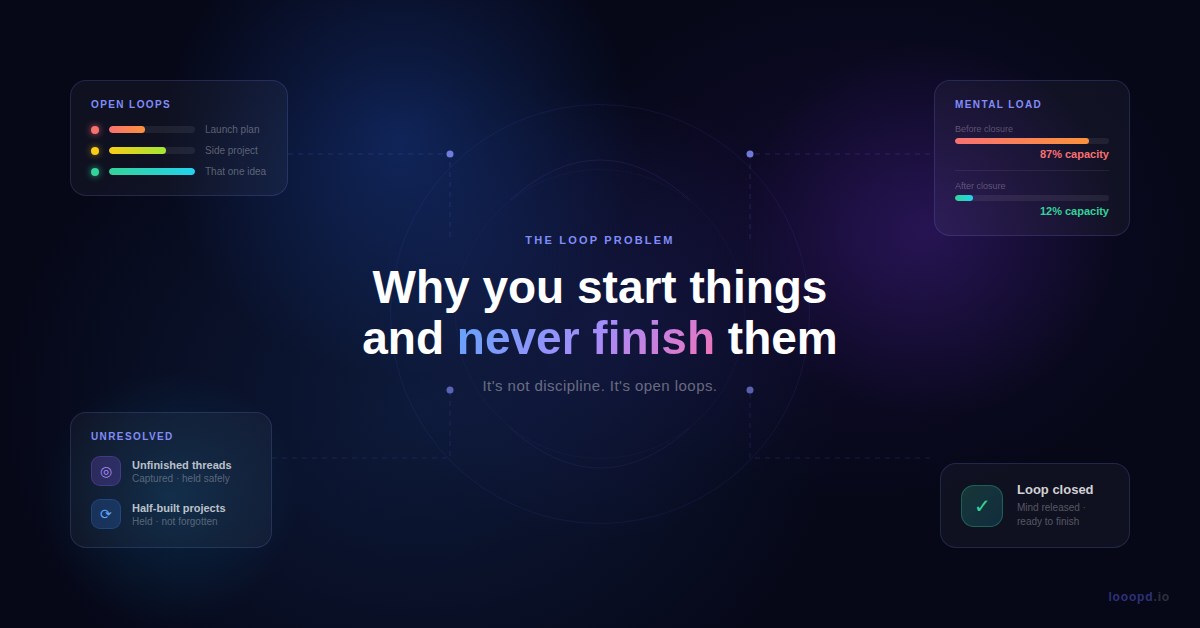
Psychologists call it the Zeigarnik Effect: incomplete tasks occupy active mental bandwidth until they’re resolved or released. Your brain keeps a running tab of everything you’ve started and haven’t finished — and it doesn’t matter how small or large the project is. That tab costs you.
You’ve felt this. It’s the 2am thought about the email you didn’t send. The nagging feeling during a good weekend that you “should” be working on that thing. The moment you sit down to build something new and realize half your energy is already spent keeping the old things alive in your head.
The longer your list of open loops, the harder it becomes to start anything new with full attention — and the harder it becomes to finish anything at all.
Why you start the next thing instead of finishing this one
There are a few patterns that show up reliably:
The clarity gap. You know what the project is, but not what this Tuesday looks like for it. Without a clear immediate action, your brain treats the project as “stuck” and routes around it.
The moving finish line. You had a vision. You built toward it. Then the vision changed — or you got feedback that complicated it — and now the destination is undefined again. You didn’t quit. You got lost.
The “good enough” question. Somewhere near completion, a voice starts asking: Is this actually ready? Will people want this? What if I put it out and it doesn’t land? This isn’t procrastination. It’s a legitimate question with no clear answer — which means another open loop your brain refuses to let go of.
Identity drift. The person you were when you started the project isn’t exactly who you are six weeks later. You’ve grown, changed priorities, encountered new information. The project no longer fits the same way — and your motivation follows suit.
The invisible prerequisite. There’s something you need to know, decide, or get access to before you can move forward — and you haven’t named it yet. So instead of making a decision, you quietly put the project down and call it “on hold.”
The real bottleneck: mental closure
Finishing projects isn’t a discipline problem. It’s a closure problem.
Your brain needs to know that a thing is:
- Held somewhere reliable — so it doesn’t have to keep it active
- Resolvable — so it can relax the open loop
- Connected to a clear next step — so it doesn’t have to solve everything at once
When those three things are true, your brain can let go. You can come back to something with full attention instead of fragmented anxiety. You can move forward with one project without the others bleeding into your focus.
When they’re not true, you start. You stall. You start something else. And you wonder what’s wrong with you.
Nothing is wrong with you. Your brain is doing exactly what it was built to do — it’s just operating on bad inputs.
What actually helps
Most productivity advice tries to solve this with external pressure: deadlines, accountability partners, streaks, commitment devices.
Some of that helps at the margins. But if the underlying loops are still open, you’re just adding pressure to a system that hasn’t been organized. It works for a while, then collapses.
The leverage is in the loop, not the pressure.
When you actually capture an open thought — a decision, a thread, a “we should talk about” — with enough context that your future self can pick it up without reconstructing everything, something shifts. The anxiety goes quiet. The mental tab closes. You’re no longer spending energy holding the thing. You’re just doing it.
The projects you finish aren’t the ones with the most accountability. They’re the ones where you always know what’s next, where you’ve made the implicit explicit, and where you’re not carrying the whole arc of the thing in your working memory all day.
The move
If you have a graveyard of started things, the answer isn’t to push harder on all of them or to feel worse about what you haven’t finished.
The move is simpler: close the loops.
Not by finishing everything — that’s not the point. By naming what’s open, deciding what actually matters, and giving the things that matter a clear home and a clear next step.
That’s the moment when “I start things and never finish them” starts to become “I actually followed through on this one.” And then again. And again.
Not because you changed. Because the system finally stopped fighting your brain and started working with it.
Looopd was built for exactly this: capturing the open threads — the conversations, decisions, half-formed ideas, and “someone needs to handle that” moments — so your mind can let go of them with the trust that they’ll surface when they’re needed. No project manager required. Just closure.